Living in the Central Valley of California, I witness firsthand the tragic reality of our mental health crisis every day. With one of the highest rates of clinician scarcity in the state, getting help has never been more difficult. Of course, this same scarcity is true across the country: millions of Americans are suffering with mental health conditions, and 70% receive no care at all.
Just as we avoid talking about poverty and health disparities without naming the systemic causes of these issues, I won’t talk about mental health suffering without acknowledging this administration’s contribution to our crisis: the crumbling economy, rising inflation and gas costs; the moral injury of being part of a country that supports genocides and terrorizes its own people. For survivors of sexual assault and those who love them, witnessing sexual-assailants occupying the highest offices in the country (the Presidency, the Supreme Court, and the Secretary of Defense), alongside an administration of enablers, is nothing short of devastating. This administration’s hostility toward its people extends to funding cuts to Medicaid and government health agencies, all of which contribute to limited access to care.
 While we may have little control over much of the above, we do have agency in deciding how we will respond to the mental health suffering of our fellow humans beings.
I believe we have only three choices; 1) continue to do what we are doing, leaving the majority of people without care, 2) trust our mental healthcare to the owners of AI, or 3) support capable, trusted community helpers to provide mental healthcare to fellow community members.
Choice 1: Continue to do what we are doing
It is not possible to solve our crisis by relying on licensed clinicians. Clinician scarcity spans the country, with rural areas hit the hardest. Worse, projections through 2033 show no improvement. Close to 50% of licensed clinicians no longer accept insurance, charging cash-only rates of up to $300 an hour. It is impossible to get enough people through graduate school and the licensing process fast enough to meet our country’s mental health needs, and even if we could, it doesn’t address the fact that this system also inadvertently reinforces systemic inequities, turning out a disproportionately white workforce.
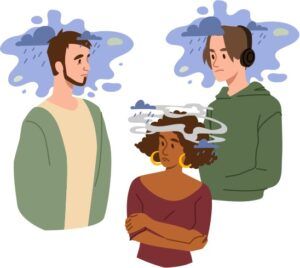
Choice 2: Trust the owners of AI
AI mental health apps are the fastest growing category of consumer and institutional software and millions are now turning to AI for mental healthcare. There are dozens of AI therapy apps on the market, but by far the most used ‘therapy’ app is ChatGPT. One study found one in eight adolescents have used AI for mental healthcare, and the Kaiser Family Foundation found one in six adults are using AI for mental healthcare. It feels like we have been rapidly swept into the wave of AI-as-therapists without ever evaluating it’s safety or merits. This seems in part due to a startling uniformity in the narrative about AI in mental health. The common set of assumptions goes something like this: ‘AI in mental healthcare is innovative, desirable, inevitable, and the only way to expand access to mental health treatment.’ This narrative seems primarily focused on the quality of AI: How good is it? How quickly can it improve? I think these are the wrong questions. The questions shouldn’t be about AI’s capabilities or its safety mechanisms; they shouldn’t be about whether AI is sophisticated enough or sufficiently human-like, and they certainly should not be about whether it is good enough…
The only important question is:
Do we entrust the care of the people we love
to the owners of AI?

The majority owners of AI—Apple, Alphabet (Google), Meta, Amazon, and Microsoft—are all for-profit corporations, with a singular focus on maximizing revenue for their shareholders. There is simply no motive for these companies to ensure our safety. Every day, more articles highlight the harm AI causes when deployed in mental healthcare. Common Sense Media and Stanford’s Brainstorm Lab evaluated the major AI mental health apps for adolescents, and found them unregulated, unstable and not sufficiently safe. Some of the most disturbing research is about AI endorsing self-harm proposals from adolescents. Just last month, the Guardian reported on the poor outcomes of Kaiser Permanente’s attempt to replace intake therapists with AI. Two mental health clinicians wrote in the New York Times last month about the superficiality and danger of chatbot therapy. The owners of AI technology (the drivers of the ubiquitous narrative of positivity about AI) will tell us it is just a matter of AI improving, yet this isn’t the problem nor the solution. The critical issue is that their central motivation will always be to extract maximum profit. Period. Trusting the owners of AI to prioritize safe mental healthcare is no different than trusting Phillip Morris with our pulmonary health, Coca-Cola with our diabetic care, or Purdue Pharma with our pain. The recent landmark lawsuits against Meta and YouTube affirmed what we all already knew: these companies have knowingly harmed our kids for decades to make more money. How can we entrust our friends, our family, our communities’ mental health to these same companies?
Choice 3: Mental Healthcare for the Community, by the Community
A safe, human-centered, and equity-inspired choice is right in front of us. We can train skilled community members to provide high-quality mental healthcare. There are thousands of people in every community who need mental healthcare, and in those same communities, there are hundreds who can provide that care. These folks—our first responders, community health workers, case managers, promotoras, legal aids, school personnel, housing navigators, and faith leaders—are already face-to-face with the mental health challenges of those they serve; they’ve been on the front lines of this crisis for years.
By providing these trusted community members training in mental health counseling and clinical support, we acknowledge the skilled helping they are already providing and enhance their confidence and skills. Research has shown that properly trained and supported ‘lay counselors’ (people who provide mental health counseling without advanced degrees or a license) can deliver care that is as effective as that provided by licensed clinicians. While this may be surprising to some, consider that the primary driver of outcomes in mental health treatment is the therapeutic alliance—an empathic relationship built between the counselor and the client. The therapeutic alliance takes enormous skill; it is multi-faceted and nuanced. It is not, however, degree-dependent. All the other therapeutic approaches, theories and strategies can be learned, degrees or no degrees.
 We have choices. Not doing anything different is making a choice. Being swept away by faithless narratives that tell us we can trust the owners of AI with our loved ones’ mental health is a choice.
Elevating the naturally skilled, trusted people in our communities to provide mental healthcare to those in need is also making a choice. It is the only one that strengthens collective belonging and centralizes human connections at a time when we need it the most.